Thursday, April 21, 2011

Escape from New Criticism

Someone I know posed the question "what else is there?" in response to a past diatribe I posted here , "No More Poems About Poetry". I replied, in a hurry, I admit, that
not everything spoken of in poetry need be funneled through a filter that refers to poetry .Poetry is meant to produce an experience through a heightened language that should,all the same,be plausible as speech.The reader should be brought inside the poet's discourse and convinced the experience was real,honest.Dependence on self awareness of form for ironic effect is,I think,a form of cheating.true,there are brilliant poets and poems about poetry.my gripe resides with the abuse of the ploy,which is pervasive and dulling. 

The point of writing poetry and of reading poetry was to see to what extent language can be extended to include those perceptions and fleeting rushes of emotion and sensation that might otherwise elude our capacity to express; it is a way of knowing ourselves in a world of others. If poetry as subject matter needed to be an issue within a poem, a problematic quirk that needed to be contended with in the expression, I had always thought it should be in the struggle for a narrator to get beyond their own contingencies and possibly experience something that was not formed on them since before birth, Stopping the discussion with poetry as the subject with little effort to poke through the veil, or faith that this can even be done, is to allow oneself to remain chained to the cave wall.


No one and nothing escapes the history of the form which born them, but what's interesting in literature, poetry in particular, are the results from those daring to dream beyond their confines in what they write . Even if the matter concludes that no one gets out of here alive, so to speak, it remains that a consequence none the less that one , writer and reader, are made a little larger, are made a little braver for the experience of realizing lies beyond the mere sensation of what our skin receives. The reflexive thing, the pondering the very form one uses to create their tales, the structuralist take down of all narrative, poetry, play or novel, being the mere result of economic determinism, is something that charged a generation or two of poets toward some inspired work , but what it has turned into, I'm afraid, is something of a wallow; it lets the poet coast on the easy excuse that there really isn't anything outside the box after all and that we might as all stay home, watch porn or baseball and discuss the impossibility of sensing anything beyond the walls. 


Even if it were true that poetry is implicitly connected to all other poems and poets, something I wouldn't dispute beyond a certain point, I find it ridiculous for poets to carpet bomb their poems with untoward, unprompted and needless mentions of other poets, of the form poetry itself, or that the writer is a poet in the company of other poets; while we may treat the whole issue of poems about poetry as an issue that is hopelessly meta, there remains a need, I think, for the poet to artfully tamp down his intellectual preferences and give his attention to what is job number one, of coming out of the clouds and presenting us with a perception that is unclouded by the overnight bags of history.

The lay of the Zoomba

Art is art because it's an expressive mission in constant flux, which means that the definitions are of what a lyric or a poem happen to be are slippery suckers indeed. Fact is, though ,is that Poe was a mediocre poet , an arch romantic rhymester given to obsessive surface effects because, I believe, he realized the vacuity of his content. One never responds emotionally to Poe's cadences; rather we appreciate them for their scansion, which is a distinction as banal as his best rhyming work. For all the talk of poems and lyrics being arbitrary distinctions at best, one needs to admit that the aesthetic of poetry has changed dramatically since the days of yore; reciting rhymed verse is more likely to seem affected and goonishly cute than stirring; there is always the genius who will rhyme brilliantly and with emotional power , but said poets are rare things. The upshot is that rhymes sound stilted, mannered, over thought to the contemporary ear. Recited sans music, one is greeted with the feeling of a peg legged man pacing a creaky wood floor. As awful as so much free poetry can be, the poets do not, by default, sound ridiculous reading their work. Theirs is a different kind of banality altogether, starting with the waste of their parent's money to send them to a writing program.


All the same, the criteria of what makes for credible poems has evolved along with the style in which poems have written; although one may take from the past and revolutionize it to some degree, it's a new set of idioms that make up the current sensibility. Dylan and others may also be the inheritors of what Poe, Crane and still others have done, but they do so in the practice in another art, related to but distinct from poetry, which is songwriting. Dylan is a songwriter, not a poet. Some would point out that Dylan did produce a book of poetry, "Tarantula", a surreal stretch of William Burroughs insomnia that suggested, yes, but had little in the way of poetic achievement, He was merely typing madly, as Capote said of Kerouac. Leonard Cohen, of course, is the logical example of someone who can both be a published poet, novelist and songwriter and achieve remarkable success in each of those forms. One does need to remind the earnest that Cohen the songwriter was not working as Cohen the poet who, in turn, was not operating under the mistaken diversion of writing a novel while thinking he was in a rehearsal for Sid Caesar  beatnik sketch, 


The lyrics to Leonard Cohen's song "Sisters of Mercy", written as lyrics , remain lyrics. In that case, Mr.Cohen is a lyricist, a songwriter. As the author of the haunting poetry sequence "Flowers for Hitler", he is a poet. He is a poet and a songwriter, and we appreciate what he does in either in both fields by related, but finely distinct standards. Poetry, written for the page, in a tone closer to vernacular speech, has greater range and may make use of more literary devices and is, as a result, capable of greater depth of feeling , allusion, association. Given the skill of the page poet, the poems have a life , a musicality when they are read aloud. Song lyrics, no matter how "poetic" they sound (or indeed, how actually brilliant they may be) , are confined to the contours of the melody they accompany. Cohen songs, Costello Songs, Dylan Songs, Mitchell songs, Hendrix songs sound stiff, silly and vaguely pretentious when read aloud, as speech, sans melody. Ours is not an age of great rhymed poetry.

The lay of the Zoomba

Art is art because it's an expressive mission in constant flux, which means that the definitions are of what a lyric or a poem happen to be are slippery suckers indeed. Fact is, though ,is that Poe was a mediocre poet , an arch romantic rhymester given to obsessive surface effects because, I believe, he realized the vacuity of his content. One never responds emotionally to Poe's cadences; rather we appreciate them for their scansion, which is a distinction as banal as his best rhyming work. For all the talk of poems and lyrics being arbitrary distinctions at best, one needs to admit that the aesthetic of poetry has changed dramatically since the days of yore; reciting rhymed verse is more likely to seem affected and goonishly cute than stirring; there is always the genius who will rhyme brilliantly and with emotional power , but said poets are rare things. The upshot is that rhymes sound stilted, mannered, over thought to the contemporary ear. Recited sans music, one is greeted with the feeling of a peg legged man pacing a creaky wood floor. As awful as so much free poetry can be, the poets do not, by default, sound ridiculous reading their work. Theirs is a different kind of banality altogether, starting with the waste of their parent's money to send them to a writing program.


All the same, the criteria of what makes for credible poems has evolved along with the style in which poems have written; although one may take from the past and revolutionize it to some degree, it's a new set of idioms that make up the current sensibility. Dylan and others may also be the inheritors of what Poe, Crane and still others have done, but they do so in the practice in another art, related to but distinct from poetry, which is songwriting. Dylan is a songwriter, not a poet. Some would point out that Dylan did produce a book of poetry, "Tarantula", a surreal stretch of William Burroughs insomnia that suggested, yes, but had little in the way of poetic achievement, He was merely typing madly, as Capote said of Kerouac. Leonard Cohen, of course, is the logical example of someone who can both be a published poet, novelist and songwriter and achieve remarkable success in each of those forms. One does need to remind the earnest that Cohen the songwriter was not working as Cohen the poet who, in turn, was not operating under the mistaken diversion of writing a novel while thinking he was in a rehearsal for Sid Caesar  beatnik sketch, 


The lyrics to Leonard Cohen's song "Sisters of Mercy", written as lyrics , remain lyrics. In that case, Mr.Cohen is a lyricist, a songwriter. As the author of the haunting poetry sequence "Flowers for Hitler", he is a poet. He is a poet and a songwriter, and we appreciate what he does in either in both fields by related, but finely distinct standards. Poetry, written for the page, in a tone closer to vernacular speech, has greater range and may make use of more literary devices and is, as a result, capable of greater depth of feeling , allusion, association. Given the skill of the page poet, the poems have a life , a musicality when they are read aloud. Song lyrics, no matter how "poetic" they sound (or indeed, how actually brilliant they may be) , are confined to the contours of the melody they accompany. Cohen songs, Costello Songs, Dylan Songs, Mitchell songs, Hendrix songs sound stiff, silly and vaguely pretentious when read aloud, as speech, sans melody. Ours is not an age of great rhymed poetry.

sometimes even the professionals need the rejection slip

 I haven't read a poem as lazily conceived as Mark Strand's "Ever So Many Hundred Years Hence" in years. Honestly, considering Strand's reputation as one of the best lyric poets still trying to make the unremarkable events in life truly memorable, this poem comes off as a middling sham. A poetry workshop would take an axe and a red pencil to it's corrosively cliched form.
A poet as acclaimed as Mark Strand should know better than to offer a paragraph so riddled with the hackneyed, the mundane and the hastily written. "Corridors of fog" would have sufficed by itself, a tangible image rarely encountered in poems, but which is ruined with the goofy adjective "milky". This is precisely the needless word a good workshop teacher would have pointedly crossed out, explaining, I think, that it's better to not over describe a situation for which the simplest, clearest , freshest image offers up the highest yield to the reader for their own associations.

 It turns a line that was okay to begin with into the tritest, laziest presentation, written by a writer who cannot trust his own instinct as to when he his done finessing a line. Worst of all, though, this paragraph is evidence of the worst quality a poet can exhibit, that of being tone deaf. Strand has strived to be a lyric poet during his published life and his work, I'm afraid, have nearly always had the quality of being self conscious aware of their own sensitivity. His language has always sounded borrowed, bound to a convenient template of convenient situations, emotions and perspective.

 This poem just boils it down to a hard, seared piece of drift wood , a dead branch of indistinguishable poesy; he is only a couple of steps removed from a greeting card sentimentality that offers, at best, in most situations, the easily grasped perspective Rod McKuen, an insufferable cartoon of would be wisdom. There might have been something spectacular in a poem that compresses decades of a man's life in only a few lines and winds up with with a plausible reunion with a long lost nephew, but even for an art as promiscuous with premise as poetry this strains credulity. This isn't a poem, it's a country western song, it's an agent's desperate for a movie he'd like to make, it's shaggy dog store sans the dog or the hair.

It is a boneyard of cliche.


Saturday, April 16, 2011

Why Are Republicans So Mean?

There's a latent worship of power , stamina and absurdly skewed masculinity , and the party of Lincoln, so called, more often than not likes to think of themselves as rugged sorts for whom any helping hand from a state agency is sure weakness, moral slack and despicable. Though a good many of them will scorch the earth in their creationist ways and continue to demonize Evolution, the irony rests in the facts that there’s a strong, rancid tendency toward Social Darwinism in their thinking. It’s not that do the Christian thing and be kind to one another, cloth and feed the poor, and in general err on the side of decency, but rather that the strong need to subjugate the poor and powerless and in turn carve up the earth’s resources .

Anyone who hasn’t power or money or status is , by default, a wretch who cannot survive the rigors of living in the real world; they and society would be better off if they died off, disappeared , vanished into the thin, fetid air that surrounds their corporate towers.

I can’t say that all Republicans are bastards—I have anecdotal evidence that a few of them have principles not linked to serving the already rich and powerful—but I’m never shocked when ever the Republicans come into power and proceed to slash funding for helpful federal programs with ease and without a pause in their stride. It’s a determinist imperative, perhaps, a hard wiring of specific genes that cannot be untwined; Republicans cannot help but be hard-throbbing assholes.

Two poems by Mark Conway

 "Vertigo" ,Mark Conway's poem published in Slate in 2005, has the definite problem of a poet who tries so hard to avoid cliche that he mistakes clown-shoed phrasing for original style. The poem reads like a man who keeps trying to say something important or intimate but is stymied ,stalled or otherwise silenced by memory lapse, fear, or head injury. The opening stanza, composed of unassigned similes and indefinite articles like "antidote", "fear" or "refined",lacks even the dignity of grandiose throat clearing; it's an open field of nagging doubt . This is the kind of
speech habit I would walk away from, and it's a writing habit that would cause me to not seek out any other poems by Mark Conway.It does not improve as the poem progresses to other stanzas, since Conway seemingly abhors clear language and chooses instead to give us the most awkward syntax he can contrive:

Wanting it, teetering
on the edge,
between falling
and crawling, back taut
against the arc
of the almost-fallen object,
backwards against
the need just
to get it
over, the wind
forced against your nostrils
as breath

One can well understand the desire to express everyday things in interesting phrases, but this is not phrasing at all, just clubfooted diction. Whatever it is he wants to talk about is deferred until the last possible moment, in an unmistakable effort to create tension and provide the poem with
momentum, but this all seems so arty, and yet there is no art. The problem, it seems, is that Conway tried to make every instance in this poem
a twisting road that was full of surprises. Simpler
sentences would help this mass of knots perfectly well, with the fancier diction cut way, way back.The payday of this poem for me is the first genuinely bad line of poetry from a Pinsky selection for the summer:

This is what fathers do
I say in the empty
tunnel of my body(!!!!!!)


(Exclamation points are mine).

The Empty Tunnel of My Body. I just want to say that phrase over and over, up and down the street, yelling it through a bullhorn. It has that acid-casualty odor that comes from old Strawberry Alarm Clock albums, or happens to the name of one of the local lunatics who shows up at open readings and whom everyone is too scared of to tell him that he's done way over his five minutes.


Another of his poems,"The First Body" ,argues that we love this life because we have craving,a fatal attraction for the afterlife where there is no labor, no exhaustion, no gravity at all. He wonders, in tight, ridiculously compressed and conditional sentences, about the struggle creatures have in order to survive in real terms.

In the morning, bowed
under blue rain, geese beat
their heavy way back
to the city-state
of mud. Rising, the wings groan,
trying to fly away
from the body.

Winter
was hard, the cold broke
weak and strong, together. Stay
and watch the robins scream
over scattered barley.

This is not a Peaceable Kingdom or a green world, but a series of struggles, striving and hard-nosed facts that are about the privations of
biological life. At first read, this makes you think of what a nature poem written by the gloomiest
Schopenhauerian a cruel world can yield. The
facts of nature are described in terms not of grace or transcendence but of pain, discomfort, death,
the slow and inevitable progress of cyclical existence.

May and the great trees rage,
white sap burned up
into leaves. Turn
and beneath the branches see
the actual air
moving, hesitant, green.
This is when the soul knows
it has a body,
by wanting
to leave it.

Trees rage, white sap makes leaves burn, the air turns hard. Images of things slowing down, of an ice age approaching.

Winter
was hard, the cold broke
weak and strong, together. Stay
and watch the robins scream
over scattered barley.


And still the suffering of living flora and fauna does not stop, and very soon we get this labored point,especially if we've been fortunate enough to have read and discussed Eliot's "The Wasteland" with an accompanying volume of Fraser's "Golden Bough" as a secondary source. There comes a time in many a poet's career where they feel they must attempt their own discourse on the cyclical nature of life, comparing geese in their "city states of mud" with a humanity that is mired in place, dreaming of great deeds and meanings while getting exactly nowhere. What delusional fools we mortals be. But again, this is a theme writ beyond redemption, and there remains a question about what Conway thought he could ad to the endlessly iterated subject.

An annoying habit of contemporary poets is the catchy ending, the sudden left turn to another idea that catches you by surprise, the last minute set of grace notes that are to bring previous stanzas which might have seemed like dissociated taxonomies into a sudden sharpness. The hope is a virtuoso turn of phrase that handsomely threads a number of beads together, and which is intended to leave us breathless. Or exasperated , if the trick doesn't work, which it doesn't here:

This is how we came to
love this life—
by wanting
the next.


This has all the makings of a young man intent on making a big statement and comes up with only

some meaning-giving statement. Here it stops being poetry and becomes naught but rhetoric, unconvincing and unfelt, conveniently all inclusive and "big" in its generality that a reader is virtually instructed to nod their head in a passive pose.

Big statements sink poems, especially poems that are situated in the junkyard of exhausted tropes. Conway the poet was less interested in waxing something profound about the ferocity with which nature and its creatures cling to life than he was in depicting the cyclical notion of life as being closer to a Beckettesque diorama of monotonous inevitability.

"I can't go on, I go on...". Life , nature, and all, are predictable, harsh and drudging things we go through against our will until death, where our reward isn't heaven or insight or superior forms of knowledge but instead just an escape from an unstamped existence to a permanent , dreamless sleep. This is what I think Conway tried to do, and he has not fully appreciated the "anxiety of influence" cast by the looming shadow of Eliot, who's genius none of us can compete with, not on his terms.Conway ought to have stepped back from his best thinking on this one and allowed the images to speak for themselves, something he could have done with a substantial rethinking and rewrite of the piece.

Friday, April 15, 2011

Beautiful and Useless

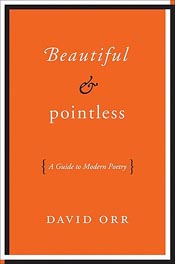
Beautiful & Pointless: a Guide to Modern Poetry
By David Orr

David Orr is a smart writer and poet who has taken on the task to add yet another apology regarding poetry and its under the radar status with most readers, yet another attempt to make the craft less off-putting to a larger audience. It is an enjoyable book , with some pleasantly worded suggestions to poet and reader that they two groups need to  meet somewhere in the middle of this battle over who is failing who in the relationship and simply share a cup of coffee. But the joining of poet and readership is not something that can be accomplished by easy suggestions ; as usual, I adhere to the pragmatist dictum that the value of any theory is in how it works, which means, to paraphrase, the allure of any poem, in any style, of any theory, of any agenda composed in English, resides mostly with the talent of the individual poet. We get into matters about how well the poet has absorbed and assimilated their readings, ie, "made them his/her own", how broadly they've outgrown their influences and progressed toward their own version of originality and genius, of course.

At the end of the day and long into the night and the following morning, what draws a reader to a poet again after a first reading was the quality of the stanzas, the line breaks, the stylization of the verbs and the spare placement of the adjectives, the use of imagery that seemed both unique and yet plausible, the use of metaphor that is delivered smoothly, invisibly, musically.

It is, I think, less a matter on whether a poet opts for simpler diction and terse couplets in regimented rhyme schemes, or a shambling flow that winds through so many associative canyon highways before coming to something resembling a poetic effect; poets are not unlike jazz improvisers of the language, which is to say that how ever they choose to address a problem they've assigned themselves, it comes down to if the writer has developed as style that has an elegance that adheres to and extends the dictates of their chosen form, if the poems in question have their activity placed in the world the poet is nominally apart of, and if this is accomplished with the least amount of pretentious self-awareness.

This is to say that what makes a poem an attractive item to return to again and to ruminate about depends on the skill the poet can forget the prevailing nonsense that "poems are always read in the context of other poems" and get on with their task of fathoming more interesting mysteries, oddities, paradoxes and alluvial epiphanies the experience of being alive, breathing and seeing brings us. There is nothing wrong with living in your head, per se, but even poets need to stop watching the dust gather on the furniture and go for a walk, a drive, a movie, a date. The modernist agenda still applies, to forge a style that meets the challenge of increasingly pervasive and insurmountable corporate speak.