Thursday, April 26, 2012

oh, come on now

“Foundling” by Billy Collins - Slate Magazine:


Former American poet laureate Billy Collins has a skill for writing about the small things that go on in his life, finding an effective means, more times than not, of tying the details of the banal and mundane into a more significant idea, lest those who assume poetry ought to be about “heavy things” feel left out of the conversation he starts. Collins is careful, though, not to get too profound and smartly lets the intellectually perplexing elements of his poetry recede and become texture in favor of something arresting, something cute being revealed, a sudden perception that wasn't there when the narrator started his discourse. It is a formula Collins uses well; the downside of it all is that it is clear that the good poet won't be digging deeper into the soil anytime soon.

Meanwhile, he is allowed to wallow and offer his readers the laziest example of his approach, in this case, a poem called "Foundling." The narrator strays across the page writing in mock wonder that he is given a life of writing things down, things seen, heard, felt, with it in mind to compose a poem for an audience that wishes, presumably, that they had the depth of perception the man holding the pen possesses. It proceeds as a typical poem-about-poetry, that retrofitted banality  that serves the writer well when they have no clear idea of which way to do with a poem they've started--it is the equivalent of a jazz musician's fake book--but it becomes ridiculous by the last stretch.

How unusual to be living a life of continual self-expression,
jotting down little things,
noticing a leaf being carried down a stream,
then wondering what will become of me,

and finally to work alone under a lamp
as if everything depended on this,
groping blindly down a page,
like someone lost in a forest.


 Aspects of Collins' audience-ready poetry bordered on the trite and ephemeral sentiment of greeting cards and books of spiritual feel-good, but there was a slight trace of cynicism. This realism kept the poems from becoming merely therapeutic. Collins remembers clearly, with snapshot clarity, being a baby perturbed at being abandoned, outside, on a winter's day, in a sewing basket, defiantly sticking his tongue out at the sky, his first act of defying fate and all other Higher Powers. Then the clever ending, the response of the invisible gods, a snowflake falls and drifts toward him. However, this conceit is unbelievable even for a form as permissive as poetry, where the only real rule is whether you have the chops to pull off an idea. Collins has chops, but they need sharpening. Cute, of course, but this is a cartoon, and not a funny one either, not clever, not thought-provoking, just time filling. I think of doodles one draws on notepads and then tosses into the trash can when the boss enters the workspace. This should be shoved in a drawer and then forgotten about. Billy Collins can do better, we know. He ought to have known better as well.

Wednesday, April 18, 2012

More Nugent: I'm 'a black Jew at a Nazi-Klan rally'

msnbc.com Entertainment - More Nugent: I'm 'a black Jew at a Nazi-Klan rally':


I grew up with Ted Nugent, literally, having seen he and his band the Amboy Dukes for a few years in Detroit during the Sixties, and later when he broke out nationally during the Seventies.

He was always a motor mouth with a reputation to live up to and, being one who apparently needed to be noticed in any easy way he could devise, made it a habit of saying outrageous contrarian things that were geared to upset the easily distracted and bring happiness to the frustrated, the stupid and the permanently gullible.

He is a fine and distinctive guitarist, to be sure, but his claim to artistry is made irrelevant by his self-creation of being a cartoon character and carnival barker disguised as a political demagogue.

Nugent is a narcissist and sociopath who hasn't the slightest hint of decency in him--he will only double down and triple down on his bombast and stupidity so long as he and not ideas are the center of attention. I would have more respect for this gun-infatuated, faux survivalist fruitcake had he, for all his big talk about supporting our troops, had actually gone into the Military and served his time in the Vietnam war.

Nugent the Warrior  has no backbone other than the crusted coating around his ego.Nugent is another gasbag fraud, a member of the loathsome GOP crowd of Chicken Hawks, IE, tough talking warmongers who haven't served a minute in uniform. Nugent made  millions as a famously sex-crazed rock star while other young men were getting shot up in Southeast Asia. Ted Nugent is a cowardly, repulsive fraud.

Saturday, April 14, 2012

GUT PUNCH


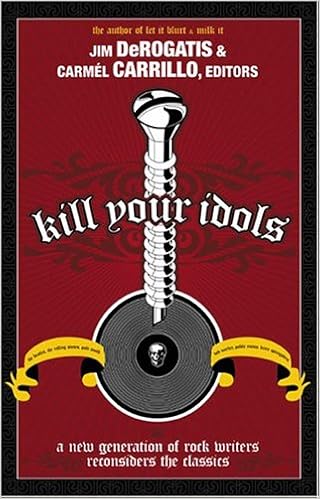
KILL YOUR IDOLS: Anti-Rock Revisionism


Image result for kill your idols derogatis
Add caption
Kill Your Idols: 
A New Generation of Rock Writers Reconsiders the Classics 
Edited by Jim Derogatis and Carmel Carillo
(Barricade)

The problem with the generation of rock critics who followed the late Lester Bangs was that too many of them were attempting to duplicate Bangs' signature and singular ability to write movingly about why rock and roll stars make terrible heroes. Like many of us, Bangs became disillusioned with rock and roll when he discovered that those he admired and was obsessed by--Lou Reed, Miles Davis, Black Sabbath--were not saints. The discovery of their clay feet, their egos, and the realization that rock and roll culture was a thick cluster of bullshit and pretentiousness didn't stimy Bangs' writing. It, in fact, was the basis of Bangs transcending his limits and finding something new to consider in this. Sadly, he died before he could enter another great period of prose writing. "Kill Your Idols", edited by Jim DeRogatis, is an anthology that is intended, I suspect to be the  antithesis to another inconsistent anthology of thematic rock commentary, "Stranded", the Greil Marcus edited collection where he commissioned a number of leading pop music writers and asked them to write at length about what one rock and roll album they would want to be left on a desert island with; it's not a perfect record--then New York Times rock critic John Rockwell chose "Back in the USA" by Linda Ronstadt and couldn't mount a persuasive defense of the disc--but it did contain a masterpiece by Bangs, his write-up of Van Morrison's album "Astral Weeks". 

His reading of the tune "Madame George" is a staggering example of lyric empathy, a truly heroic form of criticism. "Kill Your Idols", in reverse emulation, assigns a group of younger reviewers who are tasked with debunking the sacred cows of the rock and roll generation before them; we have, in effect, pages full of deadening sarcasm from a crew who show none of the humor or sympathy that were Bangs best qualities. Bangs, of course, was smart enough not to take himself too seriously; he knew he was as absurd as the musicians he scrutinized.

"Kill Your Idols" seemed like a good idea when I bought the book, offering up the chance for a younger set of rock critics to give a counterargument to the well-made assertions of the essayists from the early Rolling Stone/Crawdaddy/Village Voice days who are finely tuned critiques gave us what we consider now to be the Rock Canon. The problem, though, is that editor Jim Derogatis didn't have that in mind when he gathered this assortment of Angry Young Critics and changed them with disassembling the likes of Pink Floyd, The Beatles, the MC5; countering a well phrased and keenly argued position requires an equally well phrased alternative view and one may go so far as to suggest the fresher viewpoint needs to be keener, finer, sharper. DeRogatis, pop and rock music critic for the Chicago Sun-Times, author of the estimable Lester Bangs biography Let It Blurt, had worked years ago as record review editor of Rolling Stone and found himself getting fired when he couldn't abide by publisher Jan Wenner's policy of not giving unfavorable reviews to his favorite musicians.

His resentment toward Wenner and Rolling Stone's institutional claims of being a power broker as far as rock band reputations were concerned is understandable, but his motivation is more payback than a substantial refutation of conventional wisdom. The Angry Young Critics were too fast out of the starting gate and in a collective haste to bring down the walls of the Rock Establishment wind up being less the Buckley or the Vidal piercing pomposity and pretension than, say, a pack of small yapping dogs barking at anything passing by the backyard fence. The likes of Christgau, Marcus, and Marsh provoke you easily enough to formulate responses of your own, but none of the reviews have the makings of being set aside as a classic or a landmark debunking; there is not a choice paragraph or phrase one comes away with.

Even on albums that, I think, are over-rated, such as John Lennon's Double Fantasy, you think they're hedging their bets; a writer wanting to bring Lennon's post-Beatles reputation down a notch would have selected the iconic primal scream album Plastic Ono Band (to slice and dice. But the writers here never bite off more than they can chew; sarcasm, confessions of boredom and flagging attempts at devil's advocacy make this a noisy, nitpicky book whose conceit at offering another view of Rock and Roll legacy contains the sort of hubris these guys and gals claim sickens them. This is a collection of useless nastiness, a knee-jerk contrarianism of the sort that one overhears in bookstores between knuckle dragging dilettantes who cannot stand being alive if they can't hear themselves bray. Yes, "Kill Your Idols" is that annoying, an irritation worsened but what could have been a fine project.

The collection would have benefited nicely if they had the budget to afford writers not so much identified as rock critics but rather as critics in general, beholden to no particular canon in any medium, knowledgeable enough to understand what's in front of them and honest enough to cry not just tripe when tripe was served, but to demonstrate, by example and judicious mockery, the pretensions of the artists under scrutiny. I am thinking of Martin Amis or James Walcott, two able and incisive critics who's collected essays respectively rise far above the sludgy monotony that too soon overtakes the assortment DeRogatis and co-editor Carmel Camillo offer the public for a price.

A moment and then another moment


She crosses the street after standing at the corner for minutes that seemed nothing less than hours. He watched ,thinking of lyrics to write. She stood at the corner, jabbing the button of the pedestrian signal box, looking across the street as if to see if perhaps a store she wanted to get to before they closed might have flipped the sign over in the door, from "open" to "closed". 

As if she could see through all that traffic.
I know, he thought, a song about a guy watching a woman trying to cross the street while he tries to imagine a lyric he might or might not write. The irony, he thought, or was it just laziness? All these bagels are cold and hard as tile. He lights a cigarette, dumps the match in his ash tray. The woman is across the street, and vanished into a parking structure.
"May I have another Latte?" he asks a passing woman carrying a tray to the cafe service station.
"I don't work here" she says without breaking her stride. 

Thursday, April 12, 2012

“Aardvarks” by Philip Schultz


“Aardvarks” a poem by Philip Schultz
It’s summer and the Jitney is packed,
every seat taken, except for the one
across the aisle, in which a man
has barricaded his window seat with
a briefcase and jacket, an act meant
to confront others with his superiority.
Munching chips and guffawing at
a YouTube video of an obese woman
riding a scooter down a country road,
towing a younger obese woman
in a wheelchair, he reminds me
of a neighbor’s dog that would steal
and bury our dog’s bones, then growl
defiantly on his side of our fence.
Pythagoras believed our souls ended up
inside the bodies of animals selected
as rewards and punishments.
The three giggling girls behind me,
stretching their legs into the aisle
every time the shy attendant passes,
forcing him to stutter apologies
in a Slavic accent—poodles, probably.
Pythagoras also believed the shapes
of numbers symbolize our significance.
Well, sequestered here between work
and family, thought and dreaming,
I’m probably some kind of numinous digit
slowly evolving into, say, an aardvark
hurling down the highway inside a bus
camouflaged as a vodka bottle, on its way
to a barricaded future on the far side
of a fence where all our significance is buried.
These lines seem to exist only to deliver the image, an interesting image, that of being an aardvark in the guise of a name brand vodka secreted in a suitcase or carry on bag while on a bus barrels down the highway into the vanishing perspective of lost America. It is, I suppose, a tasty line, full of added detail and nicely fitted in the typical   murmuring cadences that typify Philip Schultz's inconsistent output, but what the poem tries to be, observational, quick witted, free associative in the effort to connect classical learning with otherwise banal detail, lacks the feeling of effortlessness. 

A poet like Billy Collins, whom I have a grudging respect for--although his work remains within boundaries that keep out the dark and allow the clarity of vision to fairly burst wide as would sunlight into a dark room from an opened door--has the discipline to chip away at the  construction and the comatose syntax and offer a poem that is clean and as close to the perception as possible: his twists and his turns sound to have been genuinely arrived at, in the moment. 

Thomas Lux, who I believe is likely the best lyric poet writing in America, has a similar compactness of expression, not chintzy and crabby, but musical, deft, melodies of lilt and carriage that  evolve strangely into darker moods, deadlier perceptions. His material is often the grim and ironic string of unintended results his subject's best ideas, plans, emotional outlooks bring them.  The point, to be sure, is that these two poets have works that actually do something--they have an effect that turns the beautiful and the tragic and even the banal goings on in daily life a matter of surprise, perception, the realization that personal narrative is a consoling myth that , while comforting and enabling of the creative artist to produce compelling  literature that resonates subtly with a readership, what happens in Life-As-Is will not obey a wholly owned plot outline. 

Schultz's poem commits no great sin and is not offensive in any sense; it just seems as if it's composed of a string of false starts that don't add up to anything powerful . It's not even interesting, in total, as minor and fleeting riff with language's ongoing struggle to capture the moment, free of cant and well worn stylistics. It reminds me of someone who talks at length, impromptu, producing a stream of words until an idea, a point actually emerges. I would be interested to read what Philip Schultz might do with that last few lines, that image, and apply it to a less gabby framework.


Monday, April 9, 2012

“Insomnia Etiquette” by Rita Dove. - Slate Magazine

“Insomnia Etiquette" by Rita Dove


 I know a little something about watching silly old movies late at night while making my through a half dozen sloppily made drinks; there is that smug satisfaction, that blurry clinging to a vague present tense that informs you that only this minute matters, that this giving into cravings, impulses and desires matters that the ridiculous black and white dramas on the television actually account for something you must pay attention to blasted though you may be.

 I am not saying that Rita Dove's protagonist in her poem "Insomnia Etiquette" has a drinking problem like the one that nearly put me under. Still, the good poet does get that feeling of what it's like to be in the middle of a numbed out mood, dealing with a series of bad days or years or taking the pause before coming to terms with some life complications that will be there in the morning when the fog has lifted, and the headache begins. I am saying that Rita Dove knows something about how  I've felt and at times recall too vividly when the memory works overtime.

Dove has a wonderful way of chipping away at the verbal excess that other poets might be tempted to smother a theme with and thereby kill the idea with a chronic reworking of cliches and tropes about drinking and heroic isolation; rather her language is spare, but not spinal, such as Charles Bukowski's tends to be. She lets the mood thrive, as it were, to define the character's fluid movement, enjoying the very fact that they are in a liquid orbit, temporarily liberated from gravity and regret. Everything else in her life is a series of emotions, confrontations, and decisions that Come Later.


 And I am thrilled that the poem is brief, with this lyric of half-verbalized contemplation refusing to devolve into a wallow or try to make something more of itself by transforming into an absurdly overwrought rant against unfair chances and bad choices. Our hero is behind enemy lines, inside the experience, aware of what comes after the escape into numbness. It is mock-heroic. One raises a glass to their waning awareness of their own absurdity and then returns to the mood's muddled center.